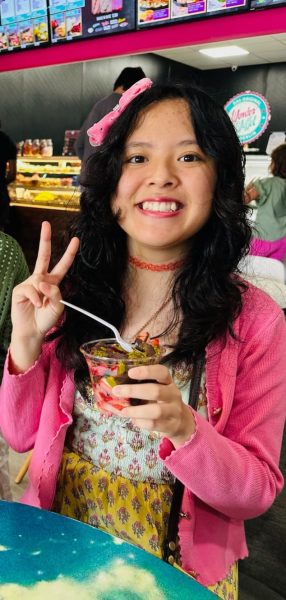












When freshman Keerthi Patsamatla came across the heart condition hypertrophic cardiomyopathy, she knew that she had found the topic for her science project.
“There hasn’t been too much research done on [hypertrophic cardiomyopathy] in the past,” Patsamatla said. “So I felt that [this project] was a really good way to explore a new condition that hasn’t really had a lot of research done.”
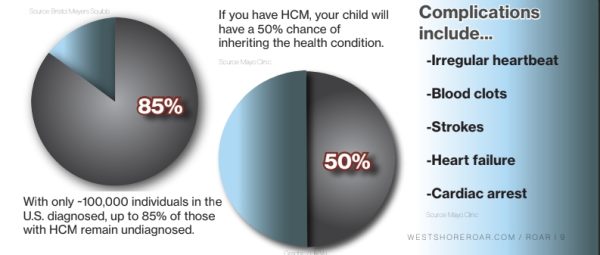
Hypertrophic cardiomyopathy (HCM) is a disorder that causes the thickening of the left chamber heart muscle, making it difficult to pump blood throughout the body. Typically seen in young athletes, the condition shows little to no symptoms in those afflicted. According to Bristol Myers Squibb, HCM remains prevalent in 1 in 200 people or 1 in 500 people, though 85% of those with HCM remain undiagnosed.
Reaah Nuñez, a registered nurse with a background in cardiovascular health, said that HCM is “genetically linked [in] 70% [of those diagnosed].”
“[With hypertrophic cardiomyopathy], children may look perfectly healthy at one moment, and yet their heart is struggling underneath the surface,” Nuñez said. “[For conditions like HCM], it’s
not just about what’s seen on the scan, but what’s sensed by the patient, or by those individuals surrounding the patient observing these changes.”
Patsamatla’s project — a portable gadget made from 3D printed parts — is made to detect HCM through the use of an integrated AI model as well as provide treatment.
“So I started initially doing research around June,” Patsamatla said. “I started formulating my project idea. It took about a month to figure out my project idea. Then I did a bunch of research from August to October. From October to the present day, I’ve been working on designing my project, getting the results, getting the methods, making my poster, [and having] all of that ready to
compete at the fair.”
Primarily, beta blockers are used to alleviate symptoms of HCM by lowering an individual’s heart rate. For detection, echodiagrams are used to create images of the human heart with sound waves. An alternative is a holter monitor, which records an individual’s cardiac activities throughout the day.
“[Beta blockers] work temporarily and aren’t really efficient,” Patsamatla said. “Also, there are some implantable different medical devices. But those are really invasive and not really as effective, since people have different varying anatomical structures, which can have an effect on how efficient those medical devices work.”
Even before the creation of her project, Patsamatla has aspired to work in the medical field, using her engineering skills to create new advancements for human health. For her previous
science project, Patsamatla built a skin cancer detector, which operated by taking dermoscopic images of affected individuals.
“I’m planning to possibly do a continuation [of this project] either next year or maybe do a different condition because I really like studying the cardiovascular system, ” Patsamatla said. “It’s really appealing to me. My niche for science is probably medical projects because I lean towards that field.”
After competing in the Brevard South Regional Science Fair on Feb. 13 at the Melbourne Square Mall, Patsamatla’s project placed 2nd in the biomedical category.
“In terms of my presentation and basically everything I had [such as my poster, I think] I gave it a really good effort,” Patsamatla said. “And I really think the judges saw the potential of my project and that was really nice.”
Patsamatla has set her sights on the International Science and Engineering Fair (ISEF) as her future destination. ISEF is an annual event where qualifying students from different countries place their projects for global recognition.
Even after the science fair, Patsamatla said she hopes she can further advance her knowledge on the subject through additional research.
“[In the future], I also want to publish some research papers in some academic journals as well,” Patsamatla said. “And probably around senior year, there’s a specific science fair competition called Regeneron Science Talent Search (STS). Basically. they pick the top 300 people [who apply for this], and then two weeks later, they actually give the results for the top 40 finalists. And I really want to be a top 40 STS finalist because you actually get to compete in Washington DC.”
Witnessing Patsamatla’s entry and results at the science fair, science research teacher Jessica Wagner said she believed her project was “one of the most impressive ones that [she had] seen [at the event].”
“This year maybe didn’t end up exactly how she wanted it to go,” Wagner said. “But I have no doubt in my mind that within these next few years, she will eventually make it to States. If she does make it to states or wins best of show, I feel like she will 1,000% make it to ISEF at some point.”