


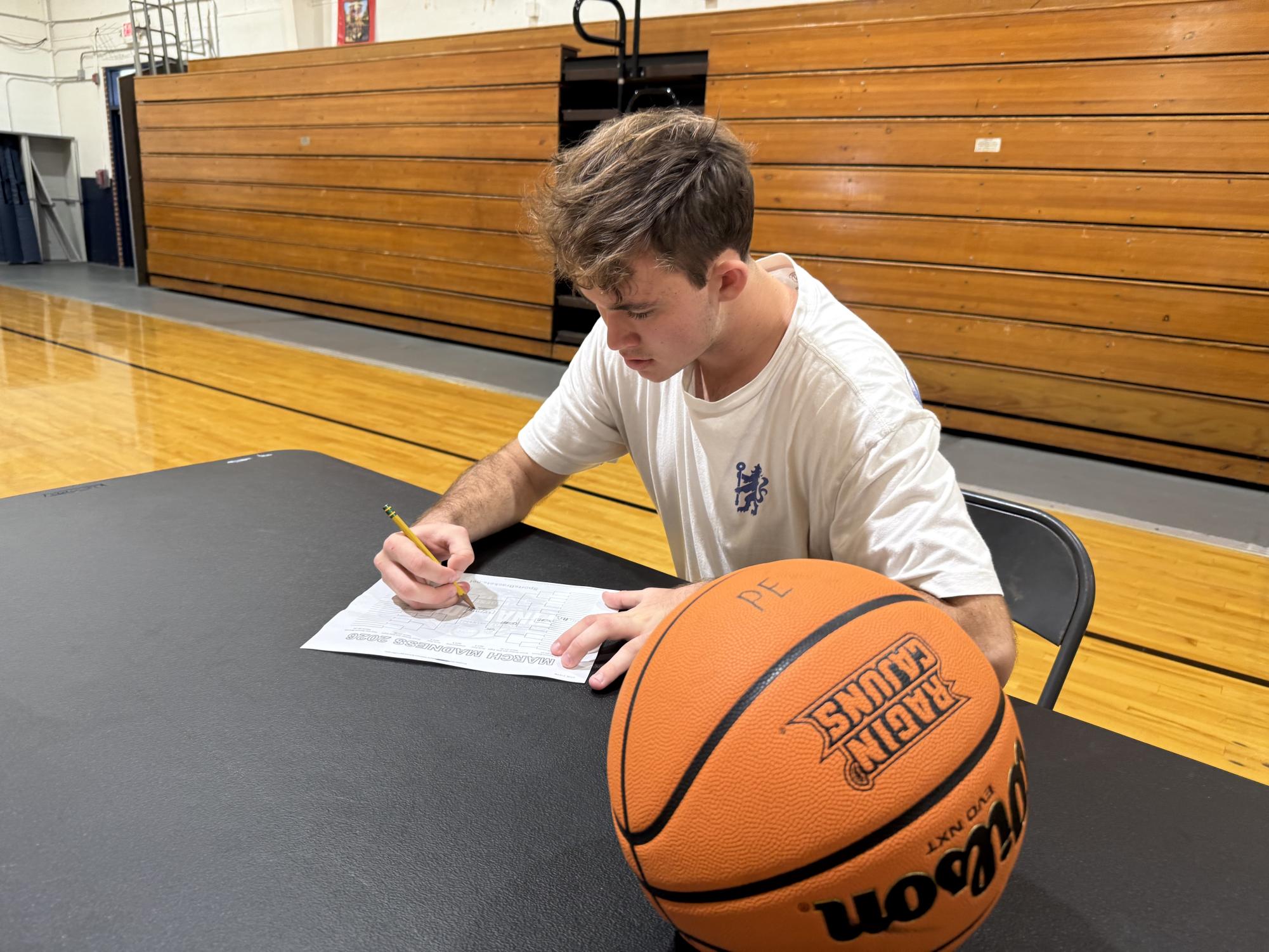
Sixty-three correct picks. With just 63 correct predictions, anyone’s name could be etched in the history books of sport forever. That’s what senior Blake Johnson thinks as he pores over his bracket for the last time before submitting it. “That’s a hope that everyone is going to be chasing,” Johnson said. “They’re thinking, ‘I’m going to be that guy. I’m going to be that special one.’ Warren Buffett even did a billion-dollar challenge if anyone gets a perfect bracket, but no one’s ever going to get it. That’s part of the fun; it’s always going to be a goal to chase until someone 100 years from now finally gets it.”
When he finally clicks the submit button on his phone, Johnson’s predictions join 26.6 million other entries in the ESPN Tournament Challenge. Each year, the NCAA Division I men’s basketball tournament, branded as March Madness, sets both diehard and casual fans abuzz with excitement as they wait to see if this year might actually be their year in the pursuit of the perfect bracket, with no incorrect picks. Filling out the winners and losers of the 64-team field before the first game tips off has become one of the most popular annual traditions for sports fans. Johnson said that the tradition’s appeal stems from its ease of access.
“It’s for everyone,” Johnson said. “I think that’s the best part of it. Anyone can make a bracket, and anyone can support the teams that they chose. That really opens it up to a lot of different people that wouldn’t normally watch college basketball.”
While the odds of filling out a perfect bracket are slim (1 in 9.2 quintillion if picking each game randomly), CBS estimated that more than 36 million bracket entries were submitted for the 2026 edition of the tournament. English teacher Lynne Bramlett said that the tradition of filling out brackets is beautiful for its community aspect.
“I have multiple brackets with multiple groups this year,” Bramlett said. “I love doing this with my students because it’s just such a fun way to connect and bond over something that we’re all passionate about.”
Bramlett said that the tournament appeals to such a wide audience for a plethora of reasons. “Who doesn’t love a Cinderella story?” Bramlett said. “It’s the one time a year where the little people can actually succeed. You have the upsets. The games are so exciting: overtime, drama, tears, stories, and buzzer beaters. It’s just amazing.”
One assignment in Bramlett’s AP Literature class, which sees students read 64 poems in a bracket and vote on which poems should move on, is inspired by the bracket-filling tradition. Bramlett said that this assignment serves as a way to deliver students more exposure to poetry in a format that interests them.
“Many students have not read a lot of poetry, and that is a third of my AP exam. Whenever you can make it a competition to engage students, it makes them work harder and buy into it. I think if you can get students to read poetry and pair it with March Madness, it’s like chocolate and peanut butter.”
Senior Jack Cahill predicted two-seed UConn to be in the championship game, unlike anyone else in the two bracket groups he joined. Cahill said his low college basketball knowledge does not matter come March.
“It was my third period, and brackets were due at noon,” Cahill said. “I opened up the website, and I thought, ‘I don’t know this team,’ so I clicked them. I did that 62 more times before my winner
was UConn.”
Selection Strategies
Four Florida universities earned bids in March Madness, those being the University of Florida, the University of South Florida, the University of Central Florida, and the University of Miami. UF was chosen as a one seed, along with three other powerhouse teams, leading to fans taking various approaches to pick games and the eventual champion. Bramlett, a UF graduate, picked the Gators to go back-to-back.
“One of my strategies is if I pick [UF] and they lose, that’s a double whammy. But if I don’t pick them and then they win, I’m happy either way,” Bramlett said. “However, the transfer portal plays a huge part, which is what [head coach Todd] Golden has done so well. So I did pick them because they did get on a hot streak. When they’re playing well, they can beat anybody in the tournament.”
Instead, the Florida Gators were knocked out in the round of 32 by the nine-seed Iowa Hawkeyes. Senior UF commit Giorgio Rotolo said he felt a great deal of frustration following the loss. “I picked Florida to win it because that’s where I’m going to go,” Rotolo said. “I was excited to watch March Madness because I’ve been a Florida fan for a while. Finally, they started winning in one of their sports last year with Walter Clayton Jr. I was at least expecting something close to a repeat this year. I was very disappointed to wake up in Spain and see that they lost, and it aggravated me even more to learn that if I had picked anyone other than Florida, I would be winning my pool.”
Principal Burt Clark, a UCF alumnus, said he was looking forward to a potential Sweet 16 matchup between 12-seed UCF and 11- seed USF. Both teams were knocked out in the round of 64.

“When you go to school somewhere, and I think that I played sports there heightens [the feeling], you want to see success,” Clark said. “The athletic success, especially in the big two, football and
basketball, does things to put your school on the map. UCF is already huge, but we’re still a young school. Athletic success is a big thing to attract students, generate revenue, and help the school
grow.”
Johnson said that while he is committed to UF, his heart remained with the Miami Hurricanes during March.
“I’m a very loyal guy. My team is the Miami Hurricanes, and I hope to see them go all the way this year,” Johnson said. “They are usually trash, but this year they got a great coach in Jai Lucas. I pick a lot of my choices with emotion, which probably isn’t good, but anything can happen with March Madness, and that’s where a lot of the fun comes from.”
The Hurricanes exited the tournament after a loss to Purdue in the round of 64. Cahill said he attributes his precise pick solely to luck and said that is why he loves March Madness.
“This event creates a great community where everybody comes together but also rivals each other,” Cahill said. “And it doesn’t matter how much you know; it just matters about what you pick, and it’s all luck-based.”