


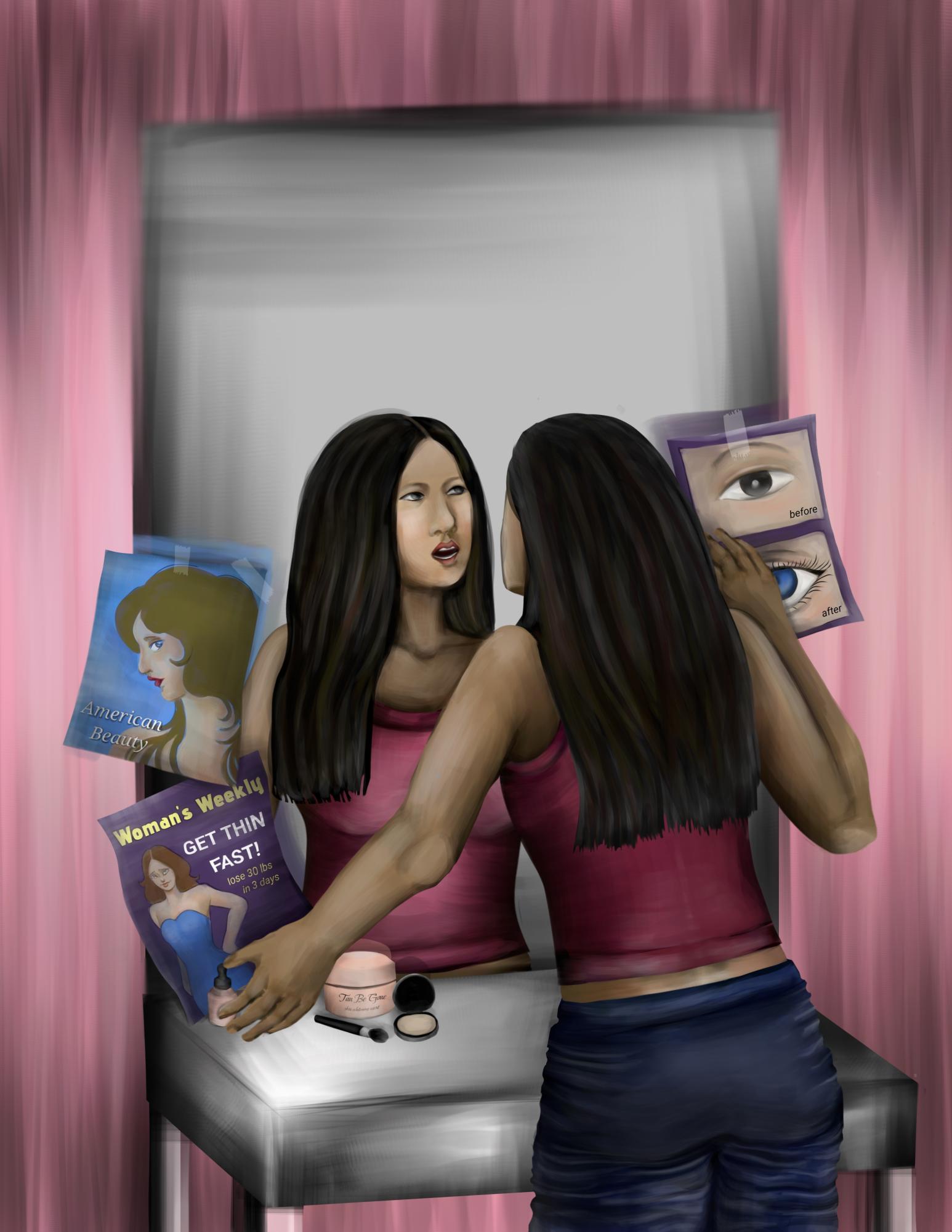
As the typical consumer walks across the local Dillard’s in the Melbourne Square Mall, a theme of Western beauty superiority becomes notable as skin-lightening products from Shiseido and Lancome are advertised. Plastered on the storefront are models with oval faces, double-lidded eyes and a small nose — all European features considered unattainable for many Asians across the globe — as the epitome of beauty. The influence of globalized beauty standards continues to take advantage of insecurities while fueling the beauty industry. Societal pressure perpetuated by modern industries makes Asian teens susceptible to toxic standards.
The increased influence of the cosmetics market has continued to warp Asians’ perception of beauty with minimal representation. More Asians are hired for movie and television roles with stereotypically European features, while those with more ethnic features continue to be sidelined. Even with the globalization of Asian entertainment, more young actresses who are considered beautiful by Eurocentric standards are selected to play lead roles, with more “ethnic” individuals being depicted as matronly, comedic or undesirable. Even in Western media, the few Asians who are represented in media continue to have stereotypically European facial features, including larger eyes. Though major movie and television production studios such as Netflix have made strides in providing more racial representation, Asian women with Western appearances continue to be hired as actresses. As a result, many Asians internalize the idea of their heritage traits being inherently unattractive.
The globalization of social media leaves young Asian women susceptible to harmful beauty norms. More beauty gurus and algorithms continue to captivate audiences through platforms such as TikTok and Snapchat. AI-driven beauty filters across these platforms promote facial characteristics such as a lighter complexion, a slimmer jawline and enlarged eyes. Though users report awareness of social media filters often being unrealistic, the popularization of filters has led to Asians becoming more self-conscious about their appearance and body image. As a result, more Asian teens use filters to “enhance” their features and to gain more validation from other users through likes. This leads to a damaging cycle of occidental features being further promoted through a globalized online algorithm.
However, the beauty standard of lighter skin has not entirely stemmed from European influence. Chinese and Japanese cultures historically considered paler skin to be the standard of beauty. Since pale skin was associated with the aristocracy, this characteristic has been associated with being of a higher class. In contrast, darker-skinned women were considered ugly, since they were primarily poorer women forced to work in the fields. This standard has only been further weaponized against Asians in the modern day, as whiter skin remains popularized, promoting colorism amongst the Asian community. The prominence of skincare pressures Asians to maintain a pale complexion for social acceptance. Even average department stores and pharmacies hold hundreds of creams and serums with skin-lightening agents and SPF.
As more young Asian women are continuously exposed to Eurocentric beauty standards, they have continued turning towards “solutions” for adhering to social norms, ranging from beauty products such as skin whitening agents to more extreme measures such as cosmetic surgery. For Asian women, operations such as rhinoplasties and blepharoplasties — a surgical procedure made to create double eyelids — have become notably more popular.
Though Asians are affected by beauty standards, every demographic is affected by the rigidity of societal expectations. Instead of relying on popular media to determine their self-esteem, everyone should focus on the beauty of being unique. Beauty is not universal, and diversity should be emphasized instead of conformity to current standards. In the shifting landscape of aesthetic appearance, staying true to oneself is the most important.