













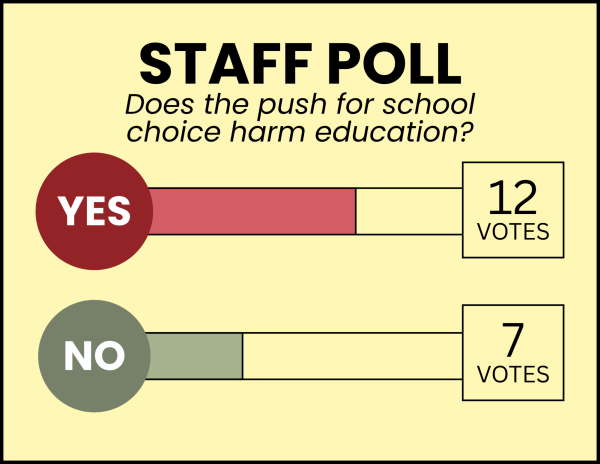
Your tax dollars help fund private schools. That’s no exaggeration. Starting in 2001, the Florida Tax Credit Scholarship helped low-income students afford private school. While initially reported to save taxpayers money by Florida’s Office of Program Policy Analysis and Government Accountability, the state’s voucher program recently took a turn for the expensive and expansive. In 2023, House Bill 1 was pushed through the state legislature and signed by the governor, granting up to $8,600 per student in voucher eligibility to every family in Florida. One thing makes that particularly egregious — that money is taken directly from the Florida Education Finance Program, which funds the school districts across Florida.
In a puzzling, reverse-Robin Hood fashion, Florida ripped away funds destined for public schools so that private institutions could be propped up with taxpayer cash. This begs the question: Why? Ask any public school teacher, administrator or staff member, and they will detail the improvements that could be made to seemingly ancient resources with relatively little cost. However, the state invested in a voucher program that cost $4 billion and made 30,000 overpayments during the 2024-2025 school year, according to an audit from the Florida Auditor General. The state seems gung-ho to spend on families who will not engage in the overarching education system.
In addition, 2025’s Senate Bill 2510 expanded the sphere of influence of charter school companies deemed “hope operators,” allowing them to move into public school facilities if a school is under capacity or underperforming. This co-location of schools creates confusion for administrators and students alike. While both charter and public schools are taxpayer-funded, they definitely don’t play by the same rules. Charter schools are not beholden to the same curricula, budgets or directives as public schools, making inevitable cross-institutional interaction a challenge. Their presence on public school facilities limits public students’ ability to fully utilize their resources, displaying how the state government pushes public education to the side.
Between the diversion of critical funding and valuable facility space from public schools to more independent, less regulated educational institutions, it is clear that Florida’s government is not doing all it can to support its public classrooms. Lawmakers who advocate these policies argue in the name of “parents’ rights,” specifically, that parents should have ultimate authority over the education of their child. They stake a fair claim. Parents should have some insight and authority into how and what their children learn; that’s why private and charter schools exist. However, operating those institutions should not strip opportunity from the 2.9 million enrolled public school students in Florida.
The neglect of public schools is having a material impact. On Jan. 20, the Brevard County School Board voted unanimously to close Cape View Elementary in Cape Canaveral due to underenrollment. In other counties, the situation is even worse. Orange County Public Schools plans to close seven schools over the coming years due to underenrollment in an effort to save funds. The underenrollment that doomed these schools is to be expected when the government lets the resources that attract students rot. The closures’ effect of student consolidation perpetuates the vicious cycle that is plaguing the public school system. Larger class sizes using the same disregarded resources lead to an undesirable educational environment, pushing students away from public education. Only investment and support that actually attracts students to public schools can save the system from a fate of disrepair.
Florida education trailblazer Mary McLeod Bethune said, “Invest in the human soul. Who knows, it might be a diamond in the rough.” Today, the state government curbs that investment. One would imagine that if Florida has $8,600 to spend on every private school student, the state must have a good track record on public per-pupil spending. But, unsurprisingly, Florida ranks eighth-lowest among all states in the category, according to the World Population Review. Florida’s state legislators evidently do not prioritize the funding of the education system they run. They have decided that private tuition payments are more important than investing in a public system that will benefit generations of Floridians to come.
Investment in public education pays off. That’s most apparent in Finland, which ranked fourth on the UN’s Education Index in 2019, compared to the tied-for-fifteenth United States. In Finland, private for-profit schooling is illegal, and basic education, school meals and learning resources are guaranteed to be free. Educators are granted significant autonomy and responsibility over their classrooms and assess students at the end of the year rather than with a standardized test. In 2021, 10.2% of its public spending went to education, illustrating how Finnish society prioritizes a public education system that serves every student. According to the Education Data Initiative, only 3.97% of taxpayer dollars go to education in the United States. The foundation built by a strong education system helps mold a society that functions well together, as shown by Finland’s ranking atop the World Happiness Report for three years running. Finland proves that, when done right, public education works not just well, but spectacularly.
The reality is that public schools hold a certain advantageous characteristic that cannot be replicated at private and charter schools, and that is real-world experience. Students can’t exist within an insulated bubble; instead, they must form a community in the situation given. Contrasting perspectives meet around every corner, and passionate debates flourish instead of stagnating echo chambers. Differing groups encounter one another, forcing humanity and empathy to conquer the separation that brews hatred.
Public education doesn’t have to be a drawback of living in Florida. It can be a great equalizer that dispenses a fair playing ground to all, even those from less fortunate backgrounds. It can be a great uplifter that encourages class mobility and the American dream with plentiful opportunities. However, those things will only happen with the requisite support from the government that is supposed to maintain and reinforce that system.
If students want to positively influence the system they learn in, they must become their own advocate. It starts from the bottom. Students can contact their school board members and attend meetings. They can call or write to the higher politicians that represent them and ask them to defend public education. Change does not happen overnight or without a fight. If students want to create a better future for themselves or those to come, they must be willing to stand up for what they believe in.