
As she settles into the car, seventh grader Arianna Levy fastens her seatbelt and pops on her headphones, pressing play on an audiobook. During long car rides, she said audiobooks give her an easy way to enjoy reading on the go.
“I love audiobooks because I can listen while I’m doing other tasks,” Levy said. “It lets me get other work done, like cleaning or laundry, while still technically reading.”
Audiobooks
Through platforms like Audible, Apple Books and Spotify, people can purchase audiobooks the same way they would regular books, and services like Libby and Hoopla offer free access to thousands of audiobooks through local libraries.
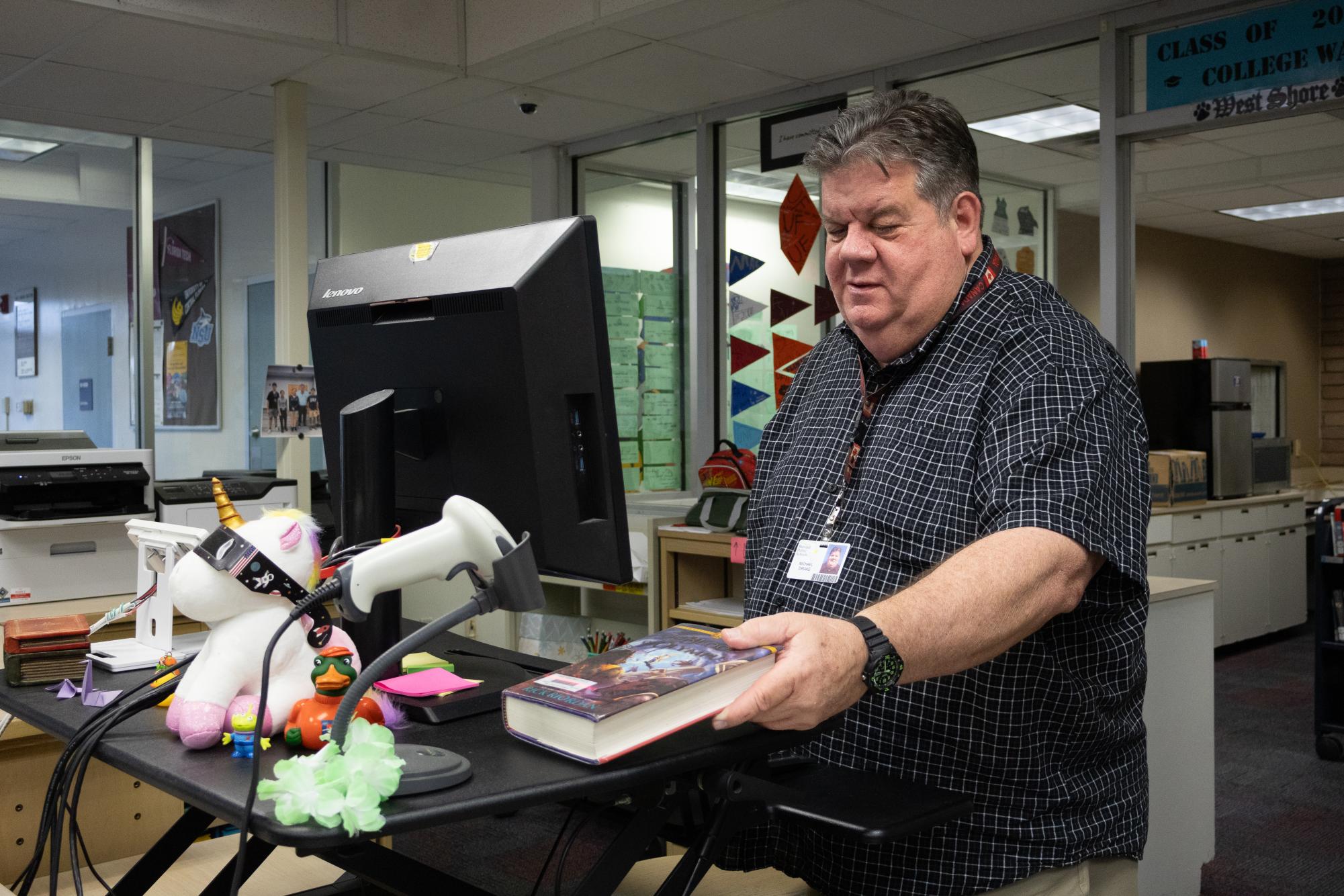
“I’m a fan of audiobooks, [especially for] when you have long drives, I think they’re really cool,” Media Specialist Mike Drake said. “Last Christmas I drove all the way across the country and back. I used Libby and the Brevard County Library system to borrow books and listen to them along the way.”
For some, the nature of audiobooks raises questions about what can be considered reading.
“If a student needs to read a book [for a class] and they get the audiobook and just listen to it, I think that’s missing the point,” Drake said. “They’re supposed to be reading the book.”
E-readers
A self-proclaimed audiobook hater, junior Annelise Henwood said she prefers how easy it is to read digitally through mediums like Kindle or Kobo.
“[With e-books] I can read whenever I really want to,” Henwood said. “[Plus], I don’t have to worry about damaging the book in the process.”
Digital books are able to remove many of the obstacles present in library systems and streamline the process.
“One of the huge advantages of e-books is instant access,” Drake said. “30 or 40 years ago if you were looking for a book, you had to find a physical copy of it. If you couldn’t find it at [the] library, you may have to go to another library or ask them to borrow it [from another library].”
The rise of e-books has led to concerns about screen time, with studies by the National Institute of Health showing that after an hour of e-reading, 75% of subjects reported mild to moderately severe eyestrain. E-readers were 95% more likely to report eyestrain.
“Computers and media cause eyestrain, most people know that,” English teacher Carrie Aune said. “If you’re doing a close reading or analysis and really focusing on the text, it will start hurting your eyes much quicker than a print book would.”
Because the formats of e-books vary — often either one continuous scrolling page or pages adjusted to the size of the screen — it can be difficult for readers to connect to the material they’re reading.
“I connect things to the actual paper,” Aune said. “If you’re scrolling through, you lose all concepts of a page and then it’s more difficult to actually understand where you are in a book. You don’t have your bearings in an online version.”
Students like senior Lindsey Hoffmann say the drawbacks of e-readers make print books a more preferable method of reading.
“I prefer print books because [they don’t] hurt my head,” Hoffmann said. “Don’t get me wrong, I love the access you get with electronic versions, but staring at a screen too long gives me massive headaches, and I already have chronic headaches, so there’s no reason to make [them] worse.”
While convenient, Hoffmann said the benefits of e-readers aren’t significant enough to outweigh the benefits of print books.
“[With] e-readers, you get access to so many more [books], and they’re accessible in so many places,” Hoffmann said. “It’s easier to bring a Kindle than a physical book, [but if] I’m going to have to bring an extra thing anyway, I might as well just bring the book.”
Traditional reading can help students create a barrier between electronic use and reading.
“I spend most of my free time reading, [and] I kind of read wherever and whenever I can,” Hoffmann said. “Doom scrolling is really hard to come back from. I try to use my phone as little as possible in the morning, so reading in the car helps make sure I can wake up but still be ready for school and not want to go back on my phone.”
E-readers can risk taking away the satisfaction students gain from reading because readers aren’t able to physically turn the page.
“It doesn’t feel the same as reading an actual book,” Henwood said. “Having the book in your hand, feeling the paper and [seeing] the cover art is different, and when you use an e-reader it just [automatically] opens to the page you were on.”
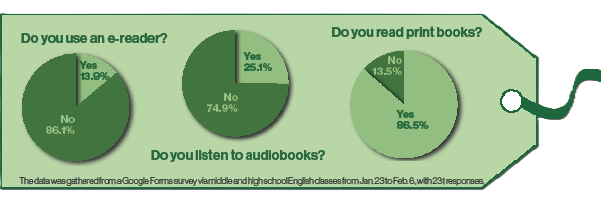
A survey given to English classes indicated that the majority of students read and prefer traditional print books instead of digital copies.
“I don’t think there’s any drawbacks to reading a print book,” Aune said. “Being able to see exactly where you are [in a book] is a huge advantage — like when Gregor’s dad pushed him out of his room [in the Metamorphosis] — I know exactly where that is spatially on the page, and you lose that with e-books.”
With the benefits and drawbacks of digital and print reading, the decision of medium ultimately depends on individual preference.
“Reading is relaxing, it makes my brain focus on the storyline and characters rather than anything that’s stressing me out,” Hoffmann said. “I use reading as a transition time, [and] it’s still an academic enough activity that I can read without feeling like I’m slacking.”