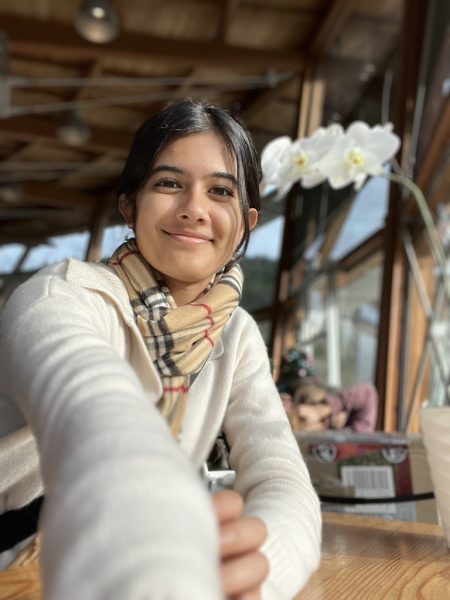

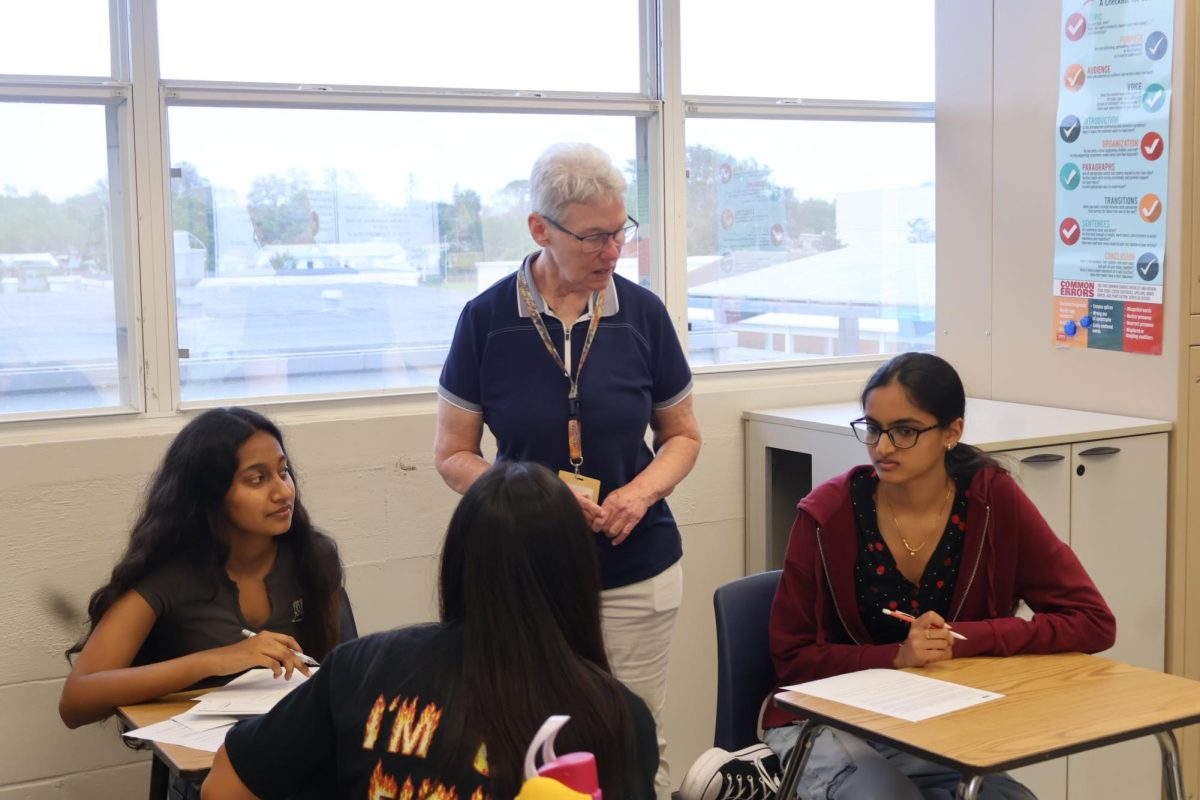
















When senior Zainab Hussain walks into her AP Physics C class, she knows she is one step closer to becoming a civil engineer. While the field is male-dominated, she was upset that the same was true for her seventh-period class. Out of the 15 students in the room, Hussain is one of two females.
“Guys are very argumentative,” Hussain said. “The girls will listen to other people more and say, ‘Oh, okay, I hear your opinion.’ But guys will just keep talking, even if it doesn’t make sense. It’s hard because I’m trying to listen to [the guys], but then [they aren’t] going to listen to me.”
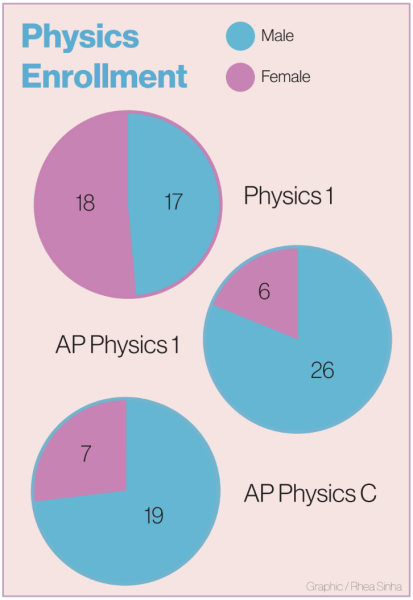
Out of the 26 students taking AP Physics C, seven are female. Meanwhile, out of the 32 students taking AP Physics 1, six are female.
“If we’re ever talking as a group, it becomes ‘Who can talk loudest? What voice prevails?’ and that’s the opinion a lot of people go with,” Hussain said. “It doesn’t matter who has the best brain or who’s actually thinking. I’ve always been soft-spoken, and especially as a woman who is soft-spoken, it makes it difficult sometimes for people to understand me, [or] to take me seriously.”
In his 10 years of teaching at West Shore, physics teacher Joseph Estevez said that female enrollment in advanced physics classes has always been lower than that of males.
While he notices conflicts in his classes, he said he is hesitant to intervene.
“I don’t know whether it’s right for me to or not to interject, to say, ‘Hey, why don’t you all shut up and let [her] talk for a little bit?’” Estevez said. “I can do that sometimes, but this is an opportunity for her to figure out how to say that herself. She’s not always going to have Mr. Estevez or anybody else there to protect her voice, so she needs to develop that skill of asserting her voice even when she doesn’t feel she’s allowed to.”
While there is less female representation in physics classes, there is no difference in performance. Last year, males comprised 60% of the AP Physics 1 population; the male pass rate was 91% and the female pass rate was 97%.
That same year, males comprised 87% of the AP Physics C population; the male pass rate was 95% and the female pass rate was 100%.
“I’ve never felt the pressure before this year of being a ‘Woman in STEM’ and [hearing that] ‘girls don’t want to do STEM,’ but I kind of get it now,” said Kellyn Hoffmann, a senior taking AP Physics C. “It’s because all these guys are really intimidating. And it’s like, ‘Jeez, get off my back, bro.’ I’m not trying to take over, I’m just trying to participate. I got a five on AP Physics 1. I am just as qualified as you are.”
A report from the American Physical Society stated that in 2020, “25% of physics bachelor’s degrees in the US went to women — the highest percentage ever recorded.”
“There’s really no way to fix this, because ‘Women in STEM’ lectures suck,” Hoffmann said. “It’s like trying to get dudes to become teachers. You can’t just convince someone to want to [go into STEM].”
Not all STEM classes at West Shore have low female representation. Biology teacher Deanna Engler said her 28-student AP Biology class has 18 girls.
“Physics and engineering are still very heavily dominated by males, and part of that is just tradition and what our expectations are, to a certain extent,” Engler said. “Part of it is that it gets reinforced in the classes. When the enrollment of females is very low, the girls don’t want to enroll in those classes because they don’t necessarily feel welcome. So it’s like, what’s the fix? We need to add girls into a place — that they don’t want to be because they don’t feel welcome — in order to have [more female enrollment]. It’s like Catch-22.”
When Engler attended college, her physics professors “called us stupid and other things that were less than polite.” She said the sexism followed her to graduate school in 1990.
“I literally had a grad school professor go off in class about how every girl in the class was wasting a man’s seat because we were just going to drop out and get married, and we shouldn’t be there — in a class that was half-female,” Engler said. “Every girl in my class graduated and did fine and still works in the science field, every one of them. We are all full-time in that field, and yet we had to sit in a class and be berated by a professor about how we were wasting a man’s seat.”
Nearly 30 years after Engler’s time in graduate school, physics and astronomy teacher Samantha Martin earned her degree in astrobiology. After having mostly male professors and classmates during her time at Florida Institute of Technology, Martin said “it would have been nice to see more women in the field.”
Out of the eight students in Martin’s AP Physics 2 class, one is female.
“I’m pretty proud of being a woman teaching physics and astronomy, just because most teachers who teach those subjects are men,” Martin said. “I’m just happy I got to do something in the field that I enjoy, [and] that really appeals to me and my skills. I’m happy to be in a position where maybe I can influence more students to be interested in the topic, especially girls.”
Estevez said his advanced physics classes should be “a training ground” for both male and female students. “That’s the beautiful thing about AP Physics C,” Estevez said. “The kids are going to pass the AP exam, so that’s not an issue. There are a lot of extra skills that you can develop that aren’t physics-related. I think those are some of the skills that [girls] can build over the course of the year that have nothing to do with physics. And that’s true of a lot of boys, too. You’re not going to fail the class [or] fail a test because you prioritized developing your argumentation skills.”
When it comes to creating a better environment in the classroom, Hoffmann said that “cooperation is key.” “You shouldn’t just scoff at someone’s opinion because I’m a girl. Like, grow up,” Hoffmann said. “But at the same time, the unfortunate reality is I’m going to have to deal with that for the next four years, and then [for my] master’s degree, which is an extra two. For six years, I will be dealing with a bunch of arrogant men in my engineering classes. Hopefully, I’m going to be in a group with another five girls and we’re all going to be best friends.”