

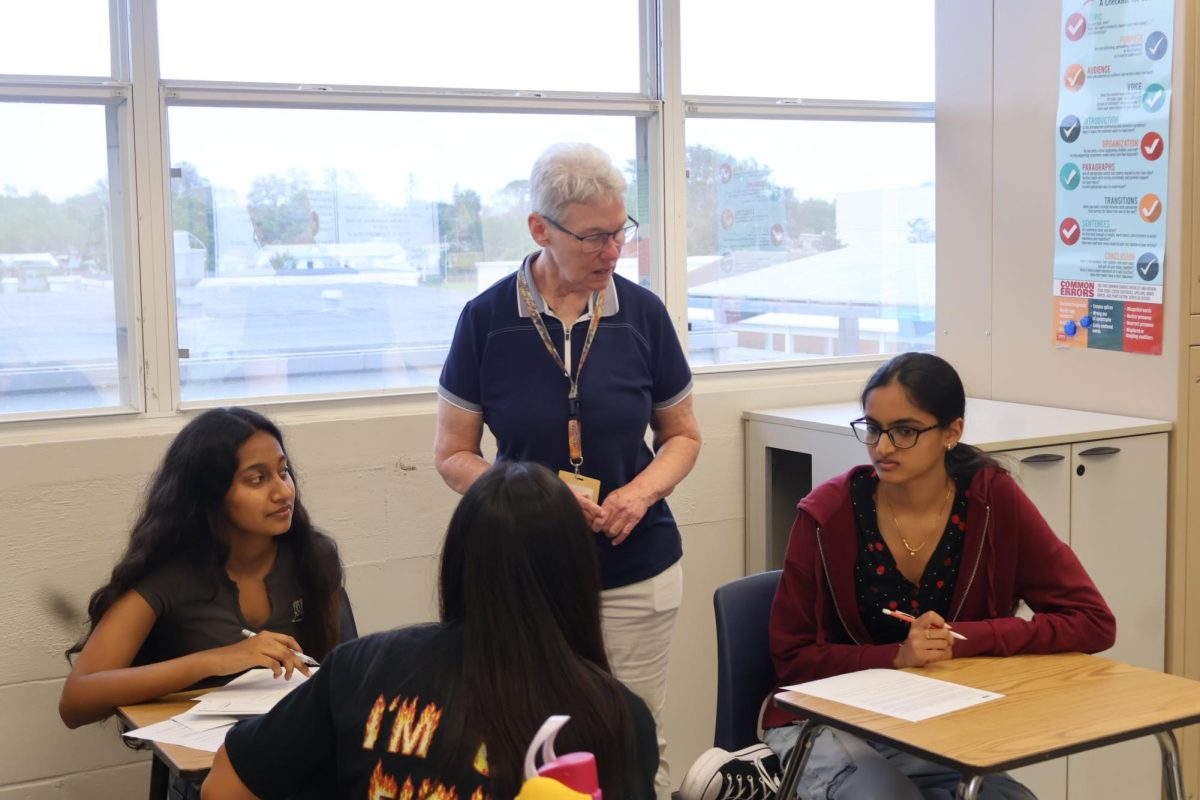

















As robotics teacher Koren Olson observes the blue light of her 13-year-old daughter’s phone hitting her face, a singular question repeats in her mind: Are her parental controls strong enough?
“Social media can be a problem, so I try to make sure my daughter’s accounts are private and limit her time online,” Olson said. “We eased up on parental controls as my kids got older, but I still try to keep an eye on what they’re doing.”
In early August, video-sharing platform YouTube began integrating artificial intelligence (AI) into its algorithm to address the issue of child safety.
This new feature aims to distinguish users’ ages based on their search history, view retention and what content they watch. YouTube CEO Neal Mohan stated in a blog post late July that the technology would “infer a user’s age and then use that signal, regardless of the birthday in the account, to deliver age-appropriate product experiences and protections.”
If the software suspects that a user is under 18, it will start adding safeguards to content being recommended and stop promoting personalized ads.
“It’s a neat way for [YouTube] to find out how old a person may be,” Olson said. “I did experience a moment a few years ago when my daughter was watching something inappropriate that she definitely shouldn’t have been watching.”
However, if the AI incorrectly guesses an age, the user can verify being over 18 by uploading a government ID or credit card. Only users who have been identified as over 18 are able to view restricted content that has been identified for adult users.
“I’d be pretty mad [if it restricted my account] because it wouldn’t let me watch some of the things I need to watch for school that cover more mature topics,” junior Raaha Vasanthakumar said.
Since users may be required to upload a photo of government identification, information is at risk of being compromised. Large corporations like Google have already had multiple data breaches.
“Putting your personal information out there is risky,” Vasanthakumar said. “If the data gets leaked, it could be a huge problem since YouTube is such a large platform.”
Other platforms are also experimenting with similar tools. Roblox, an online game creation platform, began using facial age estimation technology in July. Third-party platform Persona takes a quick facial scan from multiple angles to place users in an age bracket.
“I don’t think it will [guess my age] correctly because a lot of people tell me that I look younger than my age,” eighth grader Lily Ross said.
A 2023 FacialAI study states that AI was off nearly 2.4 years on average when guessing ages, typically overestimating teenagers’ ages and underestimating adults. Additionally, a study from the National Library of Medicine has shown that making certain expressions can throw off the technology and inaccurately estimate a person’s age.
“It’s probably not accurate, just because it has to have such a huge database of what different ethnicities and makeups would look like at different ages,” sophomore Cydnee Miranda said. “Also, if we’re so concerned about security, I don’t know why taking a scan of one’s face is much better than possibly getting on a game they’re not supposed to see.”
As AI expands, so do concerns about how it is being used.
“AI is a very useful tool when compressing information and being able to generate information quickly, like with codes, or something that’s not representing your own work,” Miranda said. “But with creative works, it really boils my blood. I don’t think it should be used to take over something that is so dearly human, like music or artwork.”
While Mohan states that YouTube is doing this to “protect [kids’] ability to explore safely online,” some people have begun using an image of Clippy, a popular Microsoft help symbol, as their profile picture to protest against the use of AI integration.
“If they modify this in the future, it could eventually be helpful,” Ross said. “But I personally am not comfortable with the AI following what I watch.”
Despite pushback, many websites could potentially adopt similar policies in the future.
“AI might not be perfect, but if it helps parents understand what their kids are doing online, that’s a good thing,” Olson said. “It just has to be done right.”